
A shoulder that becomes painful and progressively harder to move may have adhesive capsulitis, but ordinary stiffness, rotator-cuff injury, arthritis, and nerve problems require different care. You will learn how to recognize the movement pattern, when to seek assessment, what treatment can realistically achieve, and how to evaluate Ayurvedic options safely.
Key takeaways
- Frozen shoulder limits both active and passive movement, unlike ordinary muscle stiffness.
- Pain, stiffness, and recovery change across three stages; track movement and symptoms weekly.
- Seek prompt assessment for weakness, injury, fever, numbness, or sudden severe shoulder pain.
- Use Ayurvedic care alongside diagnosis, supervised mobility, and progress monitoring—not as a substitute for urgent care.
How Frozen Shoulder Differs from Ordinary Shoulder Stiffness
Frozen shoulder is more than general shoulder stiffness: the joint becomes painful and mechanically difficult to move in every direction. In adhesive capsulitis, pain often develops gradually, followed by a clear loss of active and passive range of motion.
External rotation—turning the forearm outward with the elbow at your side—is usually the first and most restricted movement.
A simple distinction is what happens when another person moves your relaxed arm. If passive movement is nearly normal but lifting the arm yourself causes weakness or pain, a rotator-cuff problem is more likely than classic frozen shoulder.
| Pattern | More likely cause | Distinguishing sign |
|---|---|---|
| Frozen shoulder | Adhesive capsulitis | Gradual pain with fixed restriction, especially external rotation |
| Rotator-cuff injury | Tendon damage | Passive movement is relatively preserved; active lifting is weak or painful |
| Bursitis or calcific tendinopathy | Inflamed tissues around the joint | Painful movement without the same fixed, multi-directional restriction |
| Arthritis | Joint-surface disease | Stiffness with grinding, persistent pain, or changes on an X-ray |
| Dislocation or fracture | Acute structural injury | Sudden pain after trauma, deformity, or inability to use the arm |
Frozen shoulder commonly makes reaching overhead, fastening clothing, placing a hand behind your back, or sleeping on that side difficult. A hot, swollen joint, fever, major trauma, unexplained weight loss, or severe unremitting night pain needs medical assessment rather than routine stiffness treatment.
The Three Stages, a Practical Self-Check, and Warning Signs
Frozen shoulder usually follows three overlapping stages over months, not a neat switch: the freezing phase brings increasing pain and shrinking movement; the frozen phase brings marked stiffness, with pain often settling; the thawing phase brings gradual return of motion.
The full course can last roughly one to three years, and recovery is not guaranteed to be complete.
Try this gentle self-check:
- Compare both shoulders while lifting your arms forward and out to the side.
- Reach toward the back of your neck, then toward the opposite shoulder blade.
- Notice whether external rotation—turning your forearm outward with your elbow by your side—is especially limited.
- Record shoulder pain at night, difficulty dressing, or trouble fastening clothing.
- Stop if movement produces sharp pain. A clinician must confirm restricted passive movement; do not force the joint or treat this check as a diagnosis.
Arrange prompt medical assessment if stiffness follows major trauma, or if you have:
- Fever, a hot or visibly swollen shoulder, or rapidly worsening pain
- Unexplained weight loss or a personal history of cancer
- Severe, unremitting night pain
- Numbness, spreading weakness, loss of coordination, or another progressive neurological deficit
- Neck pain with arm symptoms, marked weakness, or movement that is painful but not truly restricted
These patterns can point to infection, fracture, malignancy, cervical radiculopathy, or rotator-cuff disease rather than uncomplicated adhesive capsulitis.
How Doctors Confirm the Cause and Choose Treatment
Seek conventional evaluation if shoulder pain and loss of movement persist, disrupt sleep or dressing, or follow an injury. Seek prompt care for fever, an unexplained hot or swollen joint, major trauma, a history of cancer, unexplained weight loss, progressive numbness or weakness, or severe unremitting night pain.
During examination, the clinician measures active movement, then moves the relaxed arm to test passive range. Both ranges are restricted in adhesive capsulitis, with external rotation usually the clearest limitation. Near-normal passive movement with weakness during active lifting points more toward a rotator cuff disorder.
The clinician also checks the neck and nerves to separate shoulder disease from cervical radiculopathy.
| Finding | What it suggests | Imaging role |
|---|---|---|
| Both active and passive movement restricted, especially external rotation | Adhesive capsulitis | A shoulder X-ray excludes arthritis, fracture, dislocation, and other bone problems |
| Passive movement near normal but active lifting is weak or painful | Rotator cuff disease or bursitis | MRI for shoulder pain helps assess a tear when examination supports it |
| Grinding, deformity, trauma, or severe focal tenderness | Arthritis, fracture, calcific tendinopathy, or dislocation | X-ray usually comes before advanced imaging |
| Mass, infection concern, or unexplained progressive symptoms | Tumour or joint infection | MRI and laboratory tests may be needed |
A shoulder X-ray does not show the capsular inflammation itself, so a normal result does not rule out frozen shoulder. MRI is not routine for an uncomplicated frozen shoulder diagnosis; it becomes useful when examination suggests a tear, infection, or tumour. Treatment then follows the confirmed cause, not pain relief alone.
What Ayurvedic Treatment May Include—and What Evidence Supports
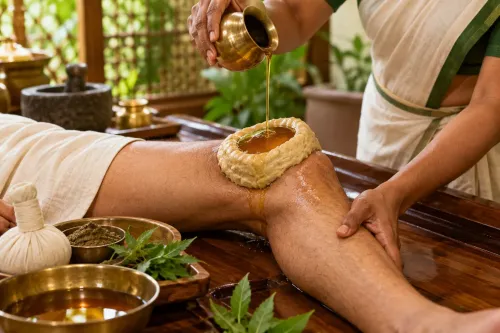
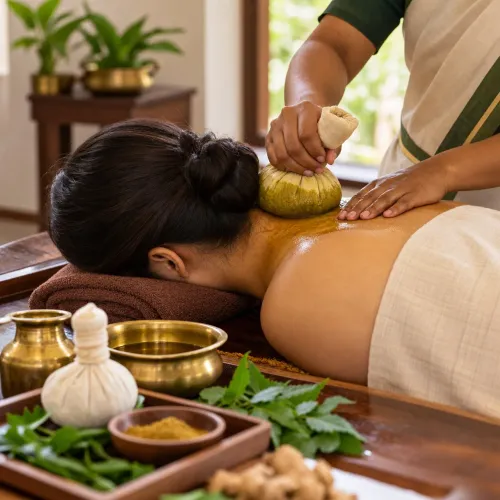
Ayurvedic treatment for frozen shoulder may fit as an adjunct to medical assessment and a supervised mobility programme, not as a replacement for either. An Ayurvedic practitioner may interpret painful stiffness through Vata-related concepts and use abhyanga (oil massage) or swedana (fomentation or heat) to ease muscle guarding and make gentle movement more comfortable.
Neither treatment has been shown to release a contracted capsule by itself.
Panchakarma for frozen shoulder requires particular caution. Panchakarma is not one standard procedure: a programme may combine massage, steam, purgation, enemas, nasal therapies, dietary restrictions, or other interventions. Evidence that it changes the long-term course of adhesive capsulitis remains limited; published research includes small observational studies, case reports, and uncontrolled comparisons.
Claims that it reliably dissolves the capsule or prevents recurrence go beyond current evidence.
Before accepting a plan, verify:
- The practitioner has recorded active and passive shoulder movement and considered cervical nerve disease, rotator-cuff injury, arthritis, fracture, infection, and malignancy.
- The plan names every procedure, session frequency, duration, and movement exercise, rather than treating “Panchakarma” as a complete protocol.
- Any oral preparation has a full ingredient list, manufacturer, batch number, and testing for lead, mercury, and arsenic. Ask about interactions and liver, kidney, or glucose monitoring.
- Diabetes, thyroid disease, prior surgery, injury, and prolonged immobilisation have been reviewed.
At Marma Ayurved And Panchkarma Clinic, ask for this written plan and clarify how progress will be measured alongside conventional follow-up. Stop routine treatment and seek medical assessment for fever, a hot swollen joint, major trauma, unexplained weight loss, cancer history, neurological decline, or severe unremitting night pain.
Related services
Bone & Joint Disorders Ayurvedic Treatment Bone & Joint Disorders Ayurvedic Treatment Natural Bone & Joint Care at Marma Ayurveda and Panchakarma Clinic At Marma Ayurveda and Panchakarma Clinic, Dr. View service → |
General Consultation ₹500 General Consultation |
Building a Safe Recovery Plan Around Mobility and Monitoring
Use pain relief to make movement possible, not to justify pushing through it. The aim is gradual restoration of motion and function; frozen shoulder recovery time can extend over months or longer.
- Reduce irritability first. Heat, gentle oil application, or massage can make movement easier, but relief does not prove that the capsule has lengthened. Avoid forceful manipulation during the highly painful phase.
- Practise frozen shoulder exercises within tolerable discomfort. Include prescribed range-of-motion exercises, then increase repetitions or reach only when pain settles rather than flares later that day.
- Add supervised physiotherapy when movement remains limited, progress stalls, or you are unsure how hard to stretch. A physiotherapist can adjust intensity to your phase and protect against compensating with the neck or shoulder blade.
- Keep medical review in the plan. If pain and motion do not improve, ask whether the diagnosis needs reassessment or whether an intra-articular corticosteroid injection is suitable; its early benefit is temporary, and it can raise blood glucose in people with diabetes.
Record progress at regular reviews instead of judging it by one comfortable session. Track external rotation, elevation, and one practical task such as dressing or reaching a shelf. Contact your clinician sooner if pain becomes steadily worse, weakness develops, or treatment causes a prolonged flare.
Stop relying on symptom relief alone when movement is not improving.
Frequently asked questions
How does frozen shoulder differ from ordinary shoulder stiffness?
Frozen shoulder causes pain and a mechanical loss of both active and passive movement in multiple directions. Ordinary stiffness often affects selected movements and may improve as the muscles warm up.
What are the three stages of frozen shoulder?
The freezing stage brings increasing pain and declining movement, the frozen stage brings marked stiffness with less pain, and the thawing stage brings gradual return of mobility.
How do doctors confirm the cause of shoulder stiffness?
Doctors assess your history, shoulder movement, strength, and nerve function. They may order an X-ray to exclude arthritis or fracture, while ultrasound or MRI helps assess rotator-cuff and other soft-tissue problems.
What can Ayurvedic treatment for frozen shoulder include?
An Ayurvedic plan may include individualized assessment, external therapies, medicines, and Panchakarma-based care. Discuss ingredients, contraindications, and interactions with a qualified clinician, and use treatment alongside appropriate diagnosis and rehabilitation.
How can you build a safe frozen shoulder recovery plan?
Use tolerable mobility exercises, avoid forceful stretching, track pain and range of motion, and review progress with a clinician. Escalate care when symptoms worsen or warning signs appear.